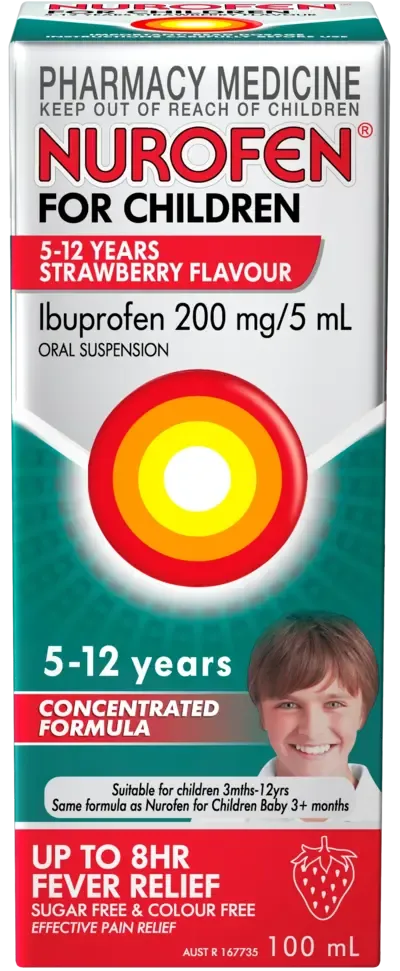


Nurofen For Children 7+ Years Pain & Fever Relief Chewable Capsules
Nurofen for Children 7+ years Soft Chewable Capsules provide headache, pain and fever relief in an easy to chew format.
Pain & Fever Pain & Fever


Children’s aches and pains might sometimes be difficult for parents to understand. You may find your child with painful bumps and bruises from all the running, jumping and climbing that growing children do, or sometimes they may complain of pain in their legs without any obvious cause – often called “growing pains.”
Here, we share some information about a few common examples of body aches and pains in children. The bad news? They can make your child uncomfortable. The good news? There is suitable relief for these pains!
A 2018 market research study by Nurofen* found that growing pains, muscular aches & pains and sprains/injuries are common causes of pain in children. Luckily, these pain occasions are usually described as mild.
When asked what triggered these types of pain, sport, activities and accidents were common responses – but interestingly, a lot of parents were unsure about the cause of growing pains.
*Quantitative survey of 821 parents with children aged 0-12 years whose children suffered from pain symptoms in the past month, followed by diaries of 1,054 parents noting details of pain occasions.
So, what are growing pains in kids? The term ‘growing pain’ refers to harmless, recurrent muscular pain that is common in children. You may see growing pains in toddlers, particularly those aged 3-5 years, or in older children especially between 8-11 years old.† Some may even continue to get them into their teenage years. While they can be very painful, there is no actual damage happening to your child’s bones or muscles, and the pain shouldn’t cause a limp or make it hard to run or play normally.
†Better Health Channel (Department of Health, State Government of Victoria, Australia). Growing pains. Available here.
What does ‘growing pains’ feel like?
If your child complains of achy pains in the muscles of their legs, they might be experiencing growing pains. Here are some growing pains symptoms to consider:
Muscular aches and pains felt in both legs
The aches are mainly found in the leg muscles, like the front of the thighs and their calves. Your child may also feel growing pains in knees but in the back of the knees rather than the joint itself (so moving the leg doesn’t affect the pain). The muscles of the arms are only occasionally affected.
Pain that comes and goes
The aches may happen every night for a week or so, or a few times a week, or only occasionally – the important thing is that it is not persistent. Pain may last from a few minutes to hours. It may also occur on and off for several years.
Typically occurs in the early evening or night
The pain tends to be worse during the night, particularly at bedtime, and may be severe enough to wake your child from their sleep. However, the pain is usually gone by morning.
If you are concerned in any way, see your doctor. You should also see your doctor if:
Causes of growing pains
While many parents may think that growing pains are caused by the growth of bones, the cause is actually unknown and bone growth hasn’t been proven to cause the pain. Some reasons that may contribute to growing pains include:
More physical activity than usual
Children’s muscles may get tired and sore if they move more than usual, though this doesn’t affect most children
Poor posture
Children who stand, sit or walk awkwardly may put greater strain on the supporting muscles of their body
Emotional upset
Stress or unhappiness may trigger aches and pains, though this doesn’t affect most children
If you are looking for growing pains treatment or are trying to figure out how to help relieve growing pains, here are some things you can try to comfort your child:
A gentle leg massage
A heat pack or warm bath
Medicines that reduce pain, such as paracetamol or ibuprofen
Plenty of cuddles and reassurance that the pain will go away
Children often injure themselves while playing, like falling over while playing sport or bumping into something. If you see swelling or discolouration, it might be a bump or a bruise.
These are common injuries that everyone will experience from time to time. Occasionally though, your child’s bump or bruise may be a more serious injury. Seek medical attention if you are concerned about your child’s injury for any reason, or if:
● Your child has intense pain
● They can’t move the injured body part, or it doesn’t work properly
● The injury is swelling and bruising very quickly
While bumps, knocks and bruises can be painful, they are usually easy to treat. Here are a few things you can try to soothe your child’s pain:
Rest the injured area
Ice with a cold pack, or ice wrapped in a cloth
Compress with a firm (but not tight) bandage
Elevate the injured area if possible
If necessary, you can also use an appropriate pain reliever containing ibuprofen, like Nurofen for Children.
Ibuprofen reduces both inflammation and pain. It can be used for mild to moderate pain in children to help make their pain less severe and help them feel more comfortable. Ibuprofen is effective for relieving muscular aches and pains and can be used to treat pain from injuries.
Nurofen for Children contains ibuprofen. It comes in a variety of formulations and can be used in children from 3 months to 12 years. Nurofen for Children liquid suspensions are sugar free and colour free and can be taken without food. For older kids, Nurofen for Children also comes as a soft chewable capsule suitable for children 7 years and older – they are easy to chew and don’t need to be taken with water, making them a convenient option.
Any child who is unwell, or in moderate to severe pain, should be seen by a doctor to find out the cause of the pain. You should also seek medical advice if you are concerned about your child’s pain for any reason, or if you’re unsure about the most appropriate way to help relieve their pain.
What is a growing pain?Growing pain refers to harmless, recurrent pain that is common amongst children. The pain is usually felt in both legs and typically occurs in the evening. It is unclear what the cause of growing pains are, but they usually resolve on their own with no lasting issues.
How to get rid of growing pains?Parents can try relieving growing pains in their children by giving a gentle leg massage, using a heat pack, or trying an over-the-counter pain reliever like Nurofen for Children. It also helps to reassure your child that the pain will go away by morning.
First published: 30th October 2021
Last updated: 4th June 2025
This article is for general information only and not intended as a substitute for medical advice. All information presented on these web pages is not meant to diagnose or prescribe. In all health-related matters, always consult your healthcare professional.
This medicine may not be right for you. Read the label before purchase. Follow the directions for use. Incorrect use could be harmful. If symptoms persist talk to your health professional. Not for use in babies under 3 months of age. RB-M-46738.