Nurofen for Children 5 to 12 Years Concentrated Pain & Fever Relief Ibuprofen 200mg/5ml Orange

There are some tell-tale signs related to fever, these can include:1,3
There are some options to help your child find some relief from their fever, including:
Here we will look at common causes of fever in children, how to measure your child’s temperature and manage their symptoms, as well as when to seek medical advice.
Fever is usually caused by the body fighting off an underlying infection. This is because raising the body temperature makes it harder for an infection to survive. Alongside viral and bacterial infections, there are also non-infectious causes, such as vaccination or underlying medical conditions.
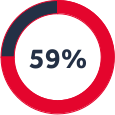
†Winkle. Nurofen diary-based pain tracker. Children (via parents). Australia. January 2018. N=500 parents of children aged 0–12 years whose children suffered from pain symptoms in the past month.
The cause of a fever will dictate whether it can be safely managed at home with rest and recovery or if there is a need to seek medical attention. Whether the fever is being caused by an infection, vaccination or any other reason, you should always monitor your child for any worsening symptoms. Most infections are mild and self-limiting (will resolve on their own). However, it's important to understand that some infections can be life-threatening. So always take a precautionary approach and seek medical advice if unsure.
There are also some things that parents should be mindful of, such as:
A body temperature between 36.5°C and 38°C is considered normal for a child.3 Typically, a temperature between 38–39°C is considered a mild-moderate fever, and a temperature of more than 39°C is considered a high fever.1 If your baby is under three months of age and has a temperature of 38°C or more, it is considered high fever, and you are advised to seek medical attention.3,5,6
What are the temperature ranges to be aware of?1,3
36.5–38°C | 38–39.0°C | 39.1°C and above |
A temperature between 36.5 and 38°C is considered a normal body temperature. | A temperature of 38–39°C or more is considered a mild to moderate fever in older infants and children. For a baby under 3 months old, with a temperature of 38°C or more, seek medical advice. | A temperature of 39.1°C or more is considered a high fever in older infants and children. |
Symptoms of a fever may include:
You should see your doctor if your child has a fever, plus any of the following:
Remember to continually monitor your child and seek medical advice if you are concerned about your child for any reason.
When checking for fever, a digital thermometer is the recommended at-home way of finding out your child’s body temperature – do not rely on hand or touch. There are also different sites of the body to take temperature from. Yet across these sites, readings may vary, so it’s important to be aware there may be differences. Picking a site is usually related to the age of your child, as some sites are more practical to get a reading from in younger children versus older ones.
You’ll also probably find a range of digital thermometers at the local pharmacy or store and are usually quick and easy to use. Just remember to always read the manufacturer's instructions and speak with a pharmacist or doctor for advice where necessary.
Some sites to take measurements from include:
Below is some guidance on digital probe thermometers and sites to measure from:
Digital probe thermometer in the armpit | These thermometers are easier to use, especially in younger children.2 Armpit measurement suit all ages, but they can be slightly less accurate and can measure up to 0.5°C lower than your child’s core temperature.2 |
Digital ear thermometer | The ear is another reading site, more so for older children and not young babies.2,7 These thermometers can be accurate if used correctly, but readings can be affected by small ear canals or earwax.7 |
Digital probe thermometer orally | This is usually an accurate way to take your child’s temperature, but it does require your child to co-operate and so is recommended for school-aged kids (five and over). It can be 0.5°C lower than more accurate sites such as the rectum.2 |
If considering a digital forehead thermometer, check with your doctor or pharmacist on whether they are appropriate for your situation. It’s also best to avoid plastic strip thermometers and mercury thermometers.
†Winkle. Nurofen diary-based pain tracker. Children (via parents). Australia. January 2018. N=500 parents of children aged 0-12 years whose children suffered from pain symptoms in the past month.
It's important to remember that lowering your child’s temperature will not help to treat the underlying cause of fever. However, there are some things you can do to make them feel more comfortable, including:
Importantly, ensure your child gets plenty of rest and remains hydrated. Continue to monitor your child’s symptoms.
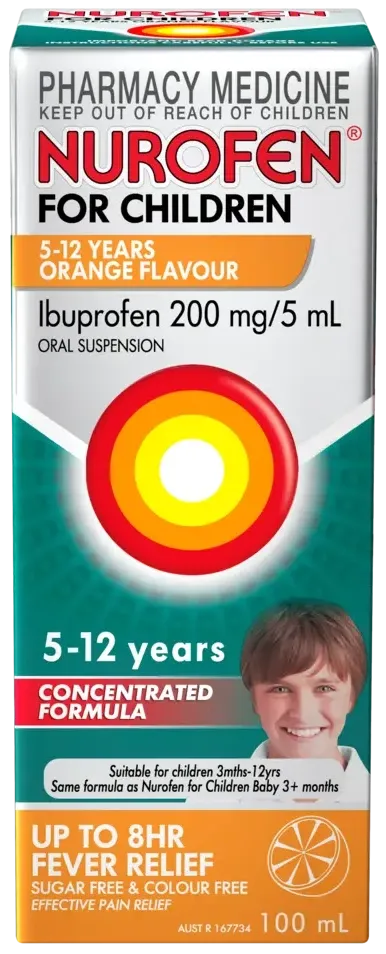
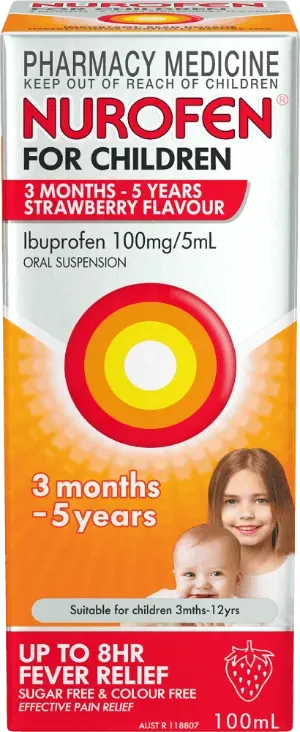
Nurofen for Children contains ibuprofen, an anti-inflammatory that helps relieve pain as well as fever in children.
Nurofen for Children oral suspensions are suitable for babies and children from three months old, offering relief from fever for up to 8 hours and can be taken on empty stomachs.8,9 For older children Nurofen for Children is also available as a soft chewable capsule from 7 years of age.
Some viruses, such as upper respiratory tract infections (URTIs), can cause the common cold and also result in fever In the case of URTIs, symptoms can last from a couple of days to a week or longer.10 If the fever has lasted for 3 days or more, see a doctor.3
While a viral infection runs its course, ensure your child gets plenty of rest and drinks enough fluids. If the fever is making your child miserable or they have other symptoms (such as a sore throat), you can give them ibuprofen or paracetamol to help provide temporary relief from the fever and pain.
A fever makes your child’s body much warmer than usual, and as a result, they will sweat more to cool down.6,11 If they don’t replace what is lost in fluids, they run the risk of dehydration.
Here are some options that may help your child stay hydrated:
Remember, dehydration can be serious, especially in very young babies as they have less heat-coping strategies than older children and adults.2 So, see a doctor immediately if you feel they are at risk of becoming dehydrated or are dehydrated.
There are a range of infections that can produce symptoms such as fever or headache. There are also non-infective causes too. For parents with a baby or child who has a fever and/or is complaining of a headache, speak with a doctor or pharmacist on what the cause may be – as well as advice for pain relief options.
Rashes are a common occurrence in children, and they can have several causes including viral infections.12 Although rashes may be common, if your child has a fever with a rash, see a doctor for further advice. Seek immediate medical attention if your child has any of the following:
Remember to always seek medical advice if your child's symptoms, including rash, worry you or if you are concerned for any reason.
This article is for general information only and not intended as a substitute for medical advice. All information presented on these web pages is not meant to diagnose or prescribe. In all health-related matters, always consult your healthcare professional.
Always read the label and follow the directions for use. Incorrect use could be harmful. NUROFEN® is a registered trademark of the Reckitt Benckiser Group of Companies. Level 47, 680 George St, Sydney 2000, NSW Australia. Prepared December 2024. RKT-M-33892.